
How Dubai Clinics Can Cut Summer Waiting-Room Overcrowding with Pre-Arrival Check-In and Virtual Queues
The pattern is instantly familiar when you go to any clinic in Dubai during the summer season. Administrative staff are busy with appointment confirmations, walk-ins, and insurance verifications, and the reception desk is always full. Outside temperatures exceed 40°C। Even if their appointment is still some time away, patients understandably prefer to arrive early and stay indoors.
From our perspective at Aristo Star, these scenes are rarely the result of excessive patient demand. More often, they reflect a structural issue in how patients move through the clinic environment. When arrivals, registration, and service order rely largely on manual coordination rather than a structured queue management system, congestion accumulates quietly throughout the day. What appears to be a “capacity issue” is often a workflow issue.
Clinics do not need to increase waiting areas or administrative staff to solve this issue। Clinics can improve patient experience and operational efficiency while significantly reducing waiting-room overcrowding with a structured patient-flow strategy supported by digital systems.
The Operational Reality Of Summer Patient Traffic
The healthcare system in Dubai is still expanding quickly. Patients now have more options than ever thanks to the thousands of licensed clinics that operate throughout the emirate. Service effectiveness has therefore emerged as a differentiator in the marketplace.
Summer introduces a predictable shift in patient behaviour. When temperatures soar, patients often arrive well ahead of their appointment times to avoid outdoor waiting. Family members frequently accompany them, and walk-in consultations tend to increase.
Operationally, clinics begin to see several recurring patterns:
- Early patient arrivals well before scheduled appointment times
- Reception desks handling multiple administrative requests simultaneously
- Walk-ins competing with scheduled consultations
- Waiting areas filling even when physicians are running on time
The bottleneck is rarely clinical capacity. The true friction point lies in how patients enter and move through the service process.
Why Traditional Waiting Rooms Struggle In Modern Clinics
For decades, healthcare facilities relied on a straightforward process. A patient arrives, registers at reception, and waits until their name or token number is called.
While this model worked in smaller, slower environments, modern outpatient clinics operate with far more administrative complexity. Reception teams must now verify identification, confirm insurance eligibility, update patient records, and log appointment data before the consultation even begins.
This responsibility considerably slows down the front desk during peak hours. The waiting room gradually fills while a line forms at reception; this isn't because doctors aren't available, but rather because administrative processing takes time.
Instead of serving as a transitional location between arrival and consultation, the waiting room effectively becomes a holding area for documents.
Pre-Arrival Check-In: Preparing Before The Patient Walks In
Changing administrative duties before the patient arrives at the clinic is one of the best strategies to deal with this problem.
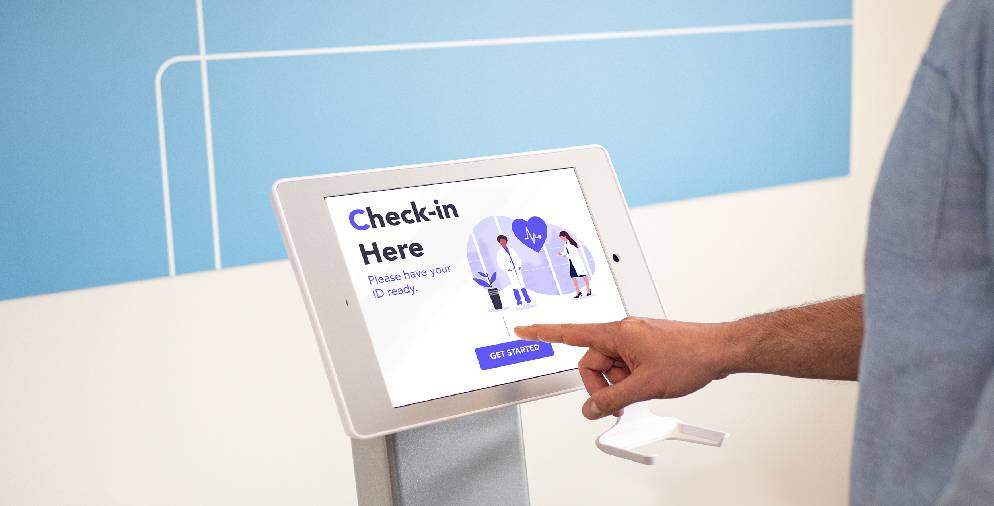
Patients can confirm appointments and provide necessary information online in advance with pre-arrival check-in. Visit confirmations, insurance paperwork, and identification information can all be completed online using mobile interfaces or secure portals.
For clinic operations, this change produces immediate benefits:
- Shorter reception queues
- Faster patient processing
- More predictable consultation schedules
- Reduced pressure on front-desk teams
Across many of the healthcare projects we support in the UAE, clinics that introduce pre-arrival check-in quickly notice a calmer reception environment and a far smoother patient intake process.
Implementing Virtual Queue Management Systems inDubai Healthcare
The second transformation comes from introducing virtual queue management. Instead of requiring patients to remain seated in the waiting room until their turn arrives, a virtual queue allows them to join the consultation flow digitally. Once checked in, patients receive updates on their queue status and estimated consultation time.
This simple shift changes the waiting experience considerably.
Patients can:
- Wait comfortably outside crowded reception areas
- Move freely within the clinic or nearby spaces
- Receive notifications when their consultation approaches
- For clinic managers and operations teams, the advantages are equally meaningful:
- Physical congestion in waiting rooms decreases
- Walk-ins and appointment patients can follow separate service flows
- Staff gain real-time visibility into queue progress
Rather than manually managing patient order, staff can focus on supporting the care journey itself.
Turning Queue Data Into Operational Insight
Digital queue platforms also unlock something clinics have historically lacked: accurate operational data.
Managers gain real-time visibility into metrics such as:
- Peak patient arrival periods
- Average waiting times
- Consultation duration patterns
- Staff utilization levels
These insights allow clinics to refine appointment scheduling, adjust staffing during peak periods, and identify workflow bottlenecks early.
Over time, clinics move from reactive queue management to data-driven service planning, improving both operational predictability and patient throughput through queue management solutions that support smarter clinic operations.
Why Patient Experience Improves Immediately
Patients judge a healthcare visit not only by the quality of treatment but also by how efficiently the experience unfolds. Long registration queues and crowded waiting areas often create unnecessary frustration, even when clinical care is excellent.
When digital check-ins and virtual queues are introduced, the improvement is immediate. Patients benefit from:
- Faster registration and intake
- Clear communication about consultation timing
- Less time spent in crowded waiting rooms
These seemingly small improvements have a powerful impact on patient perception, trust, and long-term loyalty.
Improving Clinic Flow With Smarter Systems
At Aristo Star, we work with organizations across the UAE to improve how high-traffic service environments operate. In healthcare, efficiency must always support patient comfort and care quality. Clinics manage large patient volumes every day, which requires structured and reliable patient flow.
Our experience shows that simple changes such as pre-arrival check-in, virtual queues, and operational insights can significantly improve how patients move through a clinic. These systems help organize the service journey while allowing medical teams to focus on patient care.
Summer demand in Dubai will remain high, but overcrowded waiting rooms do not have to be the result. When clinics manage patient flow in a structured way, reception processes become smoother, waiting areas stay calmer, and the overall healthcare experience becomes more organized and patient-focused.
FAQs
How can clinics reduce patient waiting times?
Clinics can shorten waiting times by using virtual queues that organize patient flow before they reach the reception desk, pre-arrival check-ins, and structured appointment scheduling.
What is a virtual waiting room in healthcare?
A virtual waiting room allows patients to check in digitally and get updates on their consultation time in real time, which reduces the need to sit down physically in crowded clinic waiting areas.
Does UAE data privacy law (PDPL) apply to virtual queues?
Yes. Aristo Star systems are designed to comply with UAE PDPL, ensuring patient data collected during pre-arrival check-in is encrypted and handled securely.