
Why In-Moment Kiosk and Tablet Feedback Beats Emailed Surveys Days Later
In-moment customer feedback
The answer lands at the counter, not in an inbox three days later
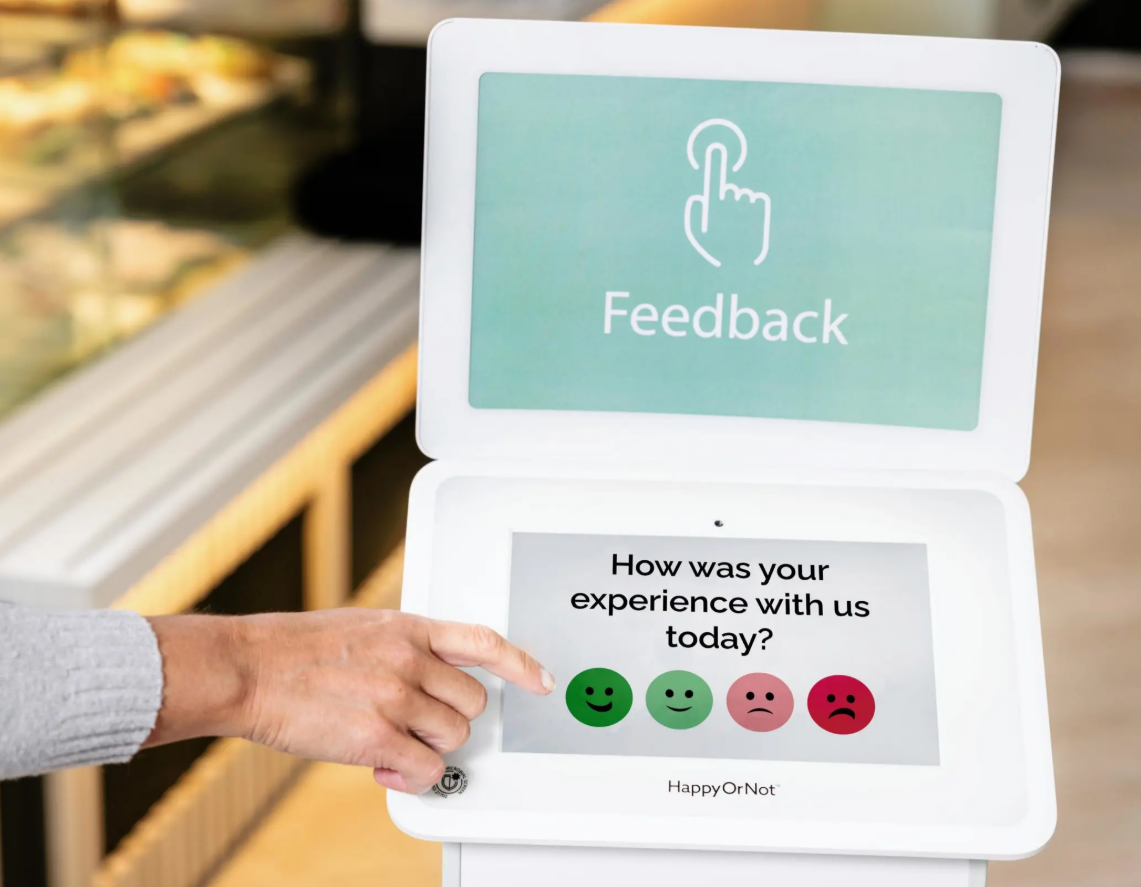
When someone finishes at a bank teller, a clinic reception or a retail checkout, they know exactly how the visit felt. Ask them right there, on a kiosk or a tablet, and you capture that feeling while it is still sharp. Send an email survey two or three days later and you are asking them to reconstruct a moment they have already half forgotten, usually while deleting the message. That gap in timing is the whole reason in-moment customer feedback tends to produce more responses, more honest ratings and problems you can still do something about.
Aristostar has been building customer experience tools in Dubai since 2006, and our feedback product, PixlCFS, sits in exactly this window: it collects short surveys on kiosks and tablets and streams the results to real-time dashboards. This guide explains why that timing matters, where it fits across UAE businesses, and where an emailed survey still has a job to do.
In-moment feedback vs emailed surveys, side by side
| What matters | Kiosk and tablet, in the moment | Email survey, days later |
|---|---|---|
| When it is asked | Seconds after the service ends | Hours or days afterwards |
| Who actually answers | Nearly everyone still present | Mostly the delighted and the furious |
| How honest it is | The real feeling, still fresh | A filtered memory of it |
| Response rate | Typically high | Often only 15 to 25 percent |
| Can you still fix it | Yes, before they leave | Rarely, the customer has gone |
The response-rate line is the one most teams underestimate. Industry benchmarks tend to put emailed survey completion in the region of 15 to 25 percent, which means three quarters of your customers are simply never heard. A kiosk sitting at the exit changes that maths, because answering takes one tap and no one has to remember a link.
The emotion is still there
A rating given at the counter reflects what the person felt during the visit. Wait a day and mood, traffic and the next errand have all painted over it.
There is almost no effort
One tap on a smiley or a star finishes the survey. No inbox to open, no password, no ten-question form to abandon halfway through.
You hear the quiet middle
Email surveys attract the extremes. In-moment capture pulls in the ordinary, satisfied-but-not-thrilled majority, which is where most of your real signal lives.
How an in-moment feedback flow actually works
Prompt at the right second
The kiosk asks as service ends, at the counter or the exit, when the memory is complete and fresh.
One simple rating
A smiley scale, thumbs, or one to five stars. Fast enough that people finish it on their way out.
An optional why
A short follow-up captures the reason behind a low or high score without forcing anyone to type.
A real-time alert
A poor rating pings the branch manager at once, so recovery can happen while the customer is still in the building.
That fourth step is where faster issue resolution comes from. When feedback is tied into the service journey, it works best alongside the wider flow: this is why treating queue, signage and feedback as one system rather than three separate tools tends to give cleaner results, and why our queue management system can trigger a feedback prompt automatically the moment a ticket is closed.

From ratings to action
Using the data to lift staff performance and experience
A rating on its own is just a number. The value appears when every response carries context: which branch, which counter, which service type, which hour. That turns raw scores into a map of where the experience is strong and where it slips.
- Compare branches and counters to see where satisfaction dips and why.
- Spot the staff members who consistently delight customers, and the ones who would benefit from coaching.
- Read time-of-day patterns so you staff the busy hours properly.
- Watch trends over weeks to check whether a fix actually worked.
Used this way, the same stream of feedback that flags an unhappy customer today also feeds the feedback insights that reduce churn over the longer run, because retention starts with catching and fixing the small frustrations before they add up.
Where it earns its place across UAE businesses
Retail and malls
A kiosk at the till or store exit catches sentiment while the shopper is still holding the bag, across busy Dubai and Abu Dhabi centres.
Restaurants and hotels
A tablet at the host stand or checkout asks about the meal or the stay before the guest walks out and the impression sets.
Clinics and hospitals
A prompt at discharge or pharmacy pickup surfaces patient experience while it counts, supporting the reporting UAE facilities are held to.
Banks and insurance
Feedback at the branch counter ties every score to a teller, a service and a time, turning a vague reputation into specific fixes.
Government service centres
A quick rating on the way out gives public bodies a clean, representative read on citizen satisfaction, counter by counter.
Events and exhibitions
Roaming tablets at a Dubai expo or conference collect impressions on the floor, when the day is still vivid for attendees.
Survey design
Writing a kiosk survey people finish
The whole advantage disappears if the survey is long. Keep it to the few things you will actually act on.
- Lead with one clear question. A single rating on the way out beats a page of questions nobody reads.
- Use faces or stars, not paragraphs. A visual scale is faster and crosses language barriers instantly.
- Offer Arabic and English side by side. In the UAE a bilingual screen lets far more people respond in the language they think in.
- Keep any follow-up optional. Let the willing add a comment; never block the finish on it.
- Cap it at two or three taps. If it takes longer than putting on a coat, it is too long.
Privacy, placement and UAE data rules
Collect less, worry less
Most in-moment surveys work perfectly with anonymous ratings and no personal data at all. When you do capture contact details for follow-up, handle them the way the UAE Personal Data Protection Law expects. Our explainer on what UAE PDPL means for feedback kiosks walks through consent and retention in plain terms.
Placement decides participation
Position matters as much as wording. A kiosk in the natural exit path, at eye level, away from the queue itself, catches people at the calm moment after service rather than in the middle of the rush. Mount it where staff cannot see the screen, and honesty rises.
A fair balance
When an emailed survey still makes sense
In-moment capture wins for immediate, in-person moments. It is not the right tool for everything, and pretending otherwise weakens the case.
- Longer, reflective studies. When you need considered answers to many questions, people give better ones sitting at a desk than standing at a counter.
- Journeys with no physical touchpoint. Online-only or delivery experiences have no exit to place a kiosk at, so a follow-up message is the natural fit.
- Feedback that needs to sit with time. Some things, like how a repair held up or whether advice paid off, can only be judged a few days later.
The strongest programmes use both: a kiosk for the moment of truth, and email for the questions that genuinely need distance.
Measuring the return on an in-moment system
Justifying the spend does not require a single headline number. It comes from a few connected effects, each of which you can track from day one.
Recovered customers
Count the at-risk visits caught by a real-time alert and turned around on the spot. Each retained customer is revenue you would otherwise have lost quietly.
Cheaper, better data
Set the cost of the kiosk programme against the surveys, incentives and chasing that low email response rates usually demand.
Operational fixes
Tie satisfaction back to staffing, wait times and specific counters, then measure the lift after each change you make.
Track those three lines for a quarter and the picture is usually clear well before the year is out.
Go deeper
See what in-moment feedback looks like in practice
If you want to see how kiosk and tablet surveys, real-time dashboards and manager alerts fit together, explore our customer feedback system on kiosks. It is the same approach described above, running across UAE branches, clinics and stores today.
Frequently asked questions
Why does in-moment feedback get more honest answers than an email survey?
Because it asks while the experience is still real. At the counter, a person reports what they actually felt during the visit. Days later, an email asks them to recall that moment through the fog of everything since, so the answer drifts toward a filtered memory rather than the truth of the interaction.
How many questions should a kiosk survey have?
As few as you will act on, ideally one core rating with an optional follow-up. A single tap on a smiley or star scale is enough to gather a representative read. Long forms are the fastest way to lose the response rate advantage that makes kiosks worthwhile in the first place.
Is collecting feedback on a kiosk compliant with UAE data rules?
Anonymous ratings with no personal data raise very few concerns. When you also collect contact details, for example to follow up on a complaint, you should apply the consent and retention principles set out in the UAE Personal Data Protection Law. Keeping the default survey anonymous is the simplest way to stay comfortable.
Where should a feedback kiosk be placed?
In the natural exit path, at eye level, and slightly away from the active queue so people answer in the calm after service rather than mid-rush. Position it so staff cannot read the screen, which noticeably improves the honesty of ratings.
Can in-moment feedback link back to a specific staff member or counter?
Yes. When feedback is connected to the queue or service system, every rating carries the branch, counter, service type and time. That lets you review performance by team member and location, and coach where it helps most, instead of guessing from a single overall score.
Do we still need email surveys at all?
Sometimes. Email is the better tool for longer reflective studies, for digital-only journeys with no physical touchpoint, and for questions that can only be judged after a few days. Most mature programmes run both: a kiosk for the moment of truth and email for the questions that need distance.
How quickly can a manager act on a poor rating?
Within minutes. A low score can trigger an immediate alert to the branch manager's dashboard or phone, so they can step in and address the issue while the customer is still on site, which is often the difference between a lost customer and a recovered one.


Related Blogs

Reducing No-Show Rates: Best Practices for Appointment Booking Systems
A clear overview of UAE strategies to reduce no-shows using improved booking design, smart reminders, analytics, and customer-first policies for better service outcomes.

Customer-Feedback Insights Reducing Churn in Retail Banking
Customer feedback, complaints, sentiment trends and behavioral signals help UAE retail banks identify early churn risk, improve predictive models and strengthen retention strategies.