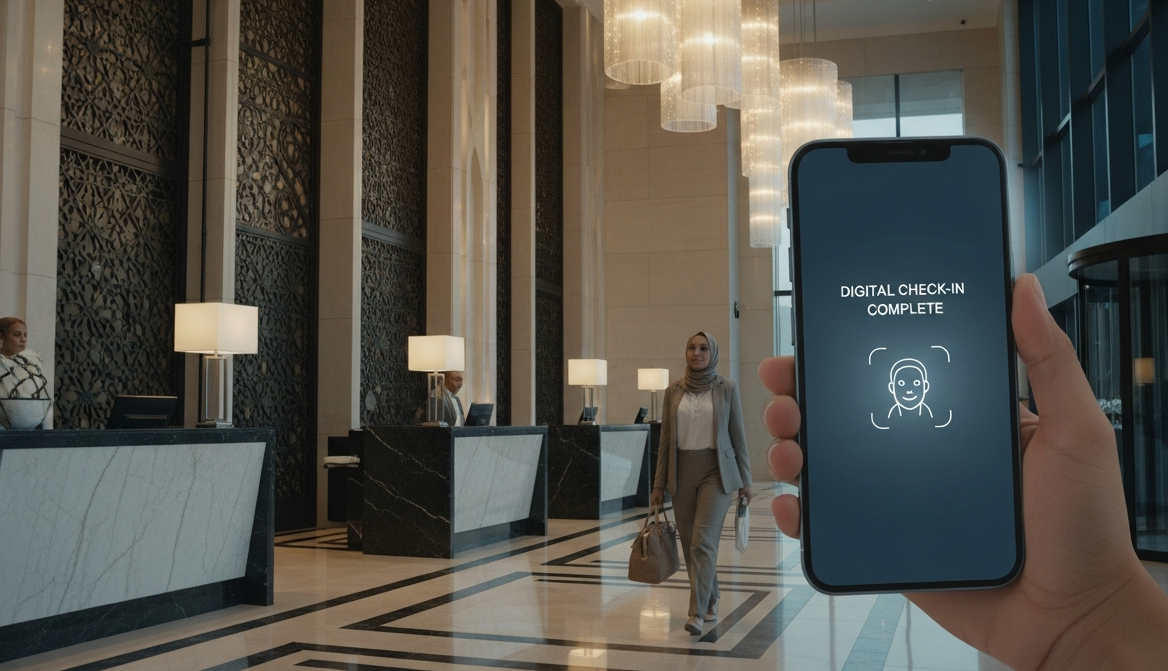

Contactless Guest Experience for UAE Hotels
The short answer
Contactless does not mean staffless
A contactless guest experience in the UAE means every routine step of a stay, registration, room access, information, service requests, payment and feedback, can be completed on the guest's own phone or on a self-service screen, without queuing at a counter. The guest chooses the channel. The front desk stays, but it stops being the bottleneck that every arrival has to pass through.
The distinction matters because most properties that describe themselves as contactless have added one QR code to a restaurant menu. A full contactless guest journey is a chain: if pre-arrival check-in works but the lobby screens still show yesterday's event listing, the guest still walks to reception to ask a question. The value comes from the whole chain, not from any single tool in it.

Why now
Dubai moved the baseline for the whole market
In December 2025 the Crown Prince of Dubai announced a citywide one-time contactless hotel guest check-in solution, developed by the Dubai Department of Economy and Tourism and offered through several authorised technology providers. Guests upload identification documents and biometric data once from their phone. The record stays valid until the identification expires, so returning visitors verify themselves with a quick facial-recognition step instead of repeating registration.
- Available for integration into hotels' existing apps and web platforms
- Covers hotels and holiday homes across the emirate
- Part of the Dubai Economic Agenda, D33
Dubai's hospitality sector counts 820 hotels and hotel apartments, and the emirate welcomed 15.70 million international overnight visitors in the first ten months of 2025, up 5% year on year. Once a share of those arrivals has registered once, they will expect to skip the desk everywhere, including at properties in Abu Dhabi, Sharjah and Ras Al Khaimah that never signed up to anything.
The contactless guest journey, stage by stage
Map the stay as a sequence of decisions the guest has to make, then ask which of them currently require a human being. The list below is the full arc most properties are working through, in the order the guest meets it.
-
Before arrival
Digital check-in and pre-arrival information
Booking confirmation carries a link. The guest can complete relevant registration steps, provide required information and receive arrival instructions before reaching the property. The administrative part of the journey starts before the guest enters the lobby.
-
Arrival
Verification, self-service and the walk to the lift
The guest completes the required arrival process through an appropriate digital or self-service touchpoint. Guests who need assistance can still be supported by hotel staff. Instead of every arrival being directed towards the same counter, guests have different paths through the lobby.
-
First ten minutes
Orientation through in-hotel screens
Lobby and lift-lobby displays answer the questions guests would otherwise walk back to ask: breakfast hours, pool and gym timings, prayer-room directions, shuttle departures, facilities and which ballroom their conference is in.
-
During the stay
Digital services and requests
Housekeeping requests, hotel information, service enquiries, restaurant information and other routine interactions can be accessed through convenient digital channels, while the appropriate hotel team handles the request behind the scenes.
-
Departure
A simpler final interaction
Where appropriate, routine departure steps can be completed digitally or through self-service. The objective is to avoid ending a convenient stay with another unnecessary queue.
-
After and during the stay
Feedback and service recovery
Short feedback interactions can be presented at relevant moments while the experience is still fresh. Issues can be directed towards the team that can respond, while post-stay feedback provides another opportunity to understand the overall journey.
What UAE hotels actually gain
Arrival peaks stop hurting
Airport arrival banks, group check-ins and event days concentrate demand into short windows. Moving appropriate steps before arrival and providing self-service options can help distribute that demand instead of sending every guest towards the same desk.
Language stops being a queue
UAE hotels serve an exceptionally diverse guest mix. Digital screens and self-service journeys can provide information in multiple languages, with Arabic and English forming an important foundation for local hospitality environments.
Staff time moves to service
Time spent on repetitive administrative interactions is time that cannot be spent assisting the guest who genuinely needs attention. Contactless processes do not remove hospitality teams; they allow more of their time to move towards service, assistance and experience.
The technology behind each touchpoint
Each stage of the journey has an established technology and systems it may need to communicate with. The integration column is often the one that decides whether a contactless project feels seamless or fragmented.
| Touchpoint | Technology | Must integrate with |
|---|---|---|
| Pre-arrival check-in | Mobile web experience, digital forms, document capture | PMS, booking environment |
| Arrival verification | Digital verification and self-service interaction | PMS, relevant registration systems |
| Arrival without a traditional desk | Self-service kiosk, tablet-assisted host | PMS, payment and access systems |
| Guest information | Digital signage, lobby and floor displays | Content management and relevant hotel information sources |
| In-stay requests | QR-accessed web journey, conversational or digital communication | Guest service and operational systems |
| Payment and departure | Digital payment and self-service processes | PMS, POS, payment environment |
| Payment and checkout | Digital wallets, tokenised cards, payment links | PMS, POS, payment gateway |
| Feedback | In-stay surveys, feedback touchpoints, post-stay surveys | Guest profile, reporting and experience systems |
QR codes, kiosks or an app: choosing the default channel
The technology question that decides adoption is not which vendor, it is which channel becomes the default. A hotel app has to be downloaded, and a guest staying three nights once a year has little reason to install one. QR codes skip the download problem entirely because the camera is already there, already unlocked and already in the guest's hand.
Kiosks earn their place where a physical action is unavoidable: printing a key card for a guest without a smartphone, scanning a passport at a resort with poor mobile coverage, or collecting a deposit in cash. An app earns its place at properties with genuine repeat business, loyalty members and multi-property groups. For most UAE hotels the practical answer is a QR-first web experience, one or two kiosks in the lobby, and an app only if the brand already has one guests use.

In-hotel
Signage is the part most hotels underuse
When the desk stops being the information point, something has to take its place in the physical building. That is the job of digital signage: not to run promotional loops, but to answer, on the wall, the questions guests used to ask a person.
- Lobby welcome screens naming the day's groups, weddings and conferences
- Wayfinding to ballrooms, spa, prayer rooms and parking levels
- Live shuttle and valet timings, and outlet opening hours that change in Ramadan
- Meeting room panels at the door showing the next booking
- Menu boards in outlets, updated centrally rather than reprinted
Three things that decide whether screens are read
Bilingual by design
Arabic and English on the same screen means half the space each, or timed alternation. Decide which, then design for it. Retrofitting Arabic onto a layout built for English produces cramped type that nobody reads at walking pace.
Fed by systems, not by staff
Content pulled from the PMS, banquet sheets and booking system stays right. Content someone updates manually each morning is wrong by Thursday, and a wrong screen sends the guest back to the desk.
Built for the environment
Screens facing a pool deck, a porte-cochere or a beachfront in a Gulf summer need brightness, heat tolerance and dust sealing that indoor panels do not have. Specify for the location, not the catalogue.
Feedback that arrives while the guest is still in the building
The most valuable feedback is the kind collected before the guest checks out, because it can still be acted on. A one-tap rating on the way out of breakfast, a comment prompt after a spa treatment, or a customer feedback system on a small kiosk near the lift lobby, each of these catches an issue at the point where the duty manager can still fix it. The same complaint, left to surface on a review platform two days later, costs a public response and a rating point.
Ask at the moment, not at the end
Short prompts tied to one service beat a long survey covering the whole stay.
Route it to an owner
A low score with no assigned department is a report, not a recovery.
Read it against operational data
Scores mean more beside arrival volumes, wait times and occupancy for the same hours.
Separate recovery from reputation
Fix first, then invite the guests who were satisfied to post publicly.
Guest data
Privacy and security are part of the design
Contactless check-in collects passport images and, increasingly, biometric data. UAE Federal Decree-Law No. 45 of 2021 on the Protection of Personal Data treats biometric information as sensitive personal data and makes explicit, informed, withdrawable consent the primary basis for processing it. Our guide to what the UAE PDPL means for booking forms, feedback kiosks and visitor data covers the same ground for other footfall-heavy sectors.
- Explicit consent, worded plainly, before any biometric capture
- A stated purpose, and no reuse of the data for a different one
- A non-biometric route for guests who decline
- Retention periods set and enforced automatically
- Encryption in transit and at rest
- Role-based access, so night audit cannot browse passport scans
- Clarity on where data is hosted and who processes it
- Contracted responsibilities with every technology vendor
- A documented breach notification path
- Guest rights honoured: access, correction, erasure
- Payment flows tokenised and PCI DSS compliant
- Audit logs kept for kiosks and staff terminals alike
Accessibility and the human option
A contactless journey that only works for a confident smartphone user is not finished. Older guests, guests of determination, families arriving with a single phone between five people, and travellers whose roaming data has not connected yet all need a route through. The difference between a rollout that raises satisfaction and one that lowers it usually comes down to what happens in the cases below.
- Kiosk screen mounted at standing height, unusable from a wheelchair
- No audio, no screen reader support, small type on a bright panel
- Guest without the app is sent back to a desk that is now unstaffed
- Arabic offered as a translation afterthought
- Staff trained on the product, not on how to rescue a stuck guest
- At least one kiosk at seated height with tactile and audio support
- High contrast, large type, and a slow-mode that removes time-outs
- A lobby host with a tablet who can complete any step for the guest
- Arabic and English treated as equal first languages
- Every front office colleague able to take over mid-transaction
What implementation actually involves
Contactless projects rarely fail on hardware. They fail on integration, on process and on the assumption that staff will work it out. A phased rollout, one touchpoint at a time, is far easier to control than a single launch across the whole journey.
Audit the systems you have
PMS, door locks, POS, payment gateway, booking engine, CRM. Establish what each one can expose through an API today, and where a middleware layer will be needed.
Fix the PMS integration first
Room status, rate and folio data have to move both ways in real time. Anything that requires a colleague to rekey a booking will be abandoned within a month of going live.
Pilot on one segment
Corporate or loyalty guests first, on one floor or one room type. Measure adoption and abandonment, then widen. A pilot also gives the team a script for the questions guests ask.
Train for the exceptions
Staff need the guest-side view, not just the admin panel. Most training time should go on failure cases: declined cards, expired documents, a guest who wants a person.
On cost, the licence is rarely the largest line. Integration work, hardware and enclosures suited to the location, network coverage in lift lobbies and back corridors, content design in two languages, and the support contract all carry weight, and they scale with the number of properties rather than the number of rooms. Hotels that already run a visitor management system for spa reception, concierge desks or event registration often find part of the groundwork is already in place.

Selection
How to judge a contactless technology provider
- Integration record. Ask which PMS and lock systems they have connected before, and to speak to the property.
- Local presence. A screen that fails on a Friday evening needs an engineer in the emirate, not a ticket queue overseas.
- One vendor or many. Check-in, signage, kiosks and feedback from one supplier removes the argument about whose fault an outage is.
- Arabic and English as standard. Interface, content tools, printed output and support, not just the guest-facing screen.
- Cloud and on-premise options. Group policy, connectivity and data residency preferences differ, and the answer should not be fixed.
- Support after handover. Response times, spares, content changes and how new outlets or floors get added later.
Frequently asked questions
Can UAE hotels legally skip in-person ID checks at check-in?
Guest registration itself is not optional, but the way it is completed has changed. Dubai's one-time contactless check-in solution, developed by the Department of Economy and Tourism, lets guests upload identification documents and biometric data from their phone in advance and then bypass the front desk on arrival. Requirements are set by the relevant authority in each emirate, so confirm the current position for your location and licence type before designing the flow.
How is Dubai's citywide check-in different from our own mobile check-in?
A property's own mobile check-in is specific to that hotel and starts again at the next one. The DET solution registers the guest once for the city: the record stays valid until the identification document expires, and repeat visitors verify themselves with a quick facial-recognition step. It is designed for integration into hotels' existing apps and web platforms, so it complements a property system rather than replacing it.
Do guests have to download an app?
They should not have to. For a guest staying a few nights, a QR code leading to a mobile web page removes the download barrier entirely and works on any phone. Apps make sense for brands with a real loyalty base and repeat stays. Most properties get better adoption from a QR-first design with a small number of kiosks for guests who prefer a screen in the lobby.
Does contactless technology mean cutting front office headcount?
In practice it changes the work rather than removing it. Registration, key encoding and folio printing shrink, while lobby hosting, service recovery and support for guests using the technology for the first time grow. Properties that plan the rollout as a headcount reduction tend to lose the service benefit that justified the investment.
What does contactless check-in need from our PMS?
Two-way, real-time exchange of reservation, room status, rate and folio data, usually over a REST or SOAP interface. The check-in platform must be able to read availability, write the registration, trigger key issuance and post charges without anyone rekeying. Where a legacy PMS cannot expose what is needed, middleware is the usual bridge, and that work belongs in the project scope from the start.
How should we handle biometric and passport data?
Treat it as sensitive personal data under UAE Federal Decree-Law No. 45 of 2021. That means explicit and informed consent that the guest can withdraw, a single stated purpose, encryption in transit and at rest, role-based access, defined retention periods and a clear contractual split of responsibility with the technology provider. Always keep a non-biometric alternative for guests who decline.
What is the sensible order to roll things out?
Start where the queue is: pre-arrival check-in and arrival. Add mobile keys once the lock system integration is proven. Bring in signage next, because it absorbs the questions that used to go to the desk. Then add in-stay requests, mobile checkout and feedback. Each phase should be piloted on one guest segment and measured before the next one starts.
Keep reading
The most common reason a contactless programme underdelivers is that check-in, screens and feedback are bought as three separate projects. We wrote about that failure mode in detail.