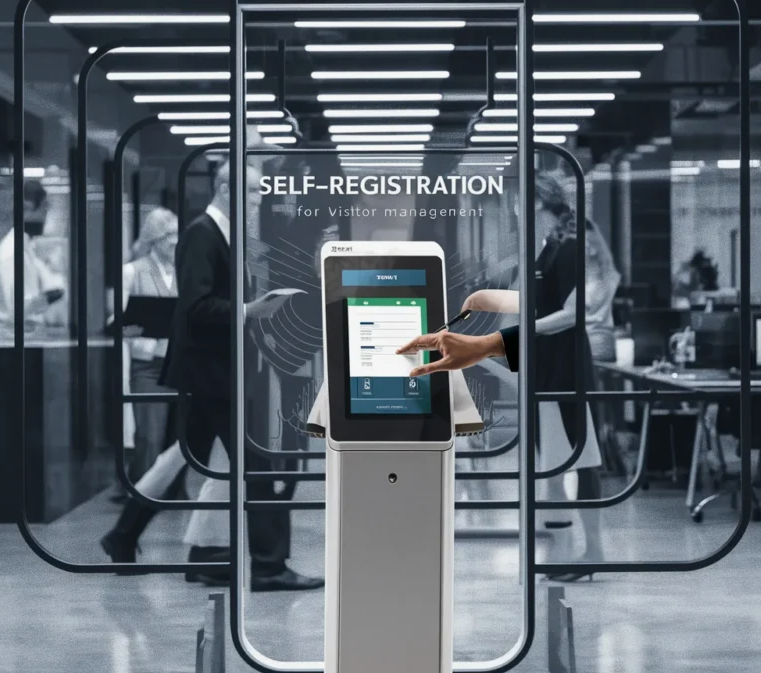

Visitor Management System for UAE Offices
The basics
A visitor management system, in plain terms
A visitor management system is software that handles every person who walks into your building and does not work there. Guests, contractors, couriers, candidates, auditors, engineers doing a chiller service at two in the afternoon: the system registers them, checks who they are, tells the host they have arrived, decides which doors they can open, and records when they left. In most UAE offices it replaces a spiral-bound book on the reception counter and a security guard squinting at an Emirates ID.
That description sounds administrative. In practice the system sits at the intersection of three things a facilities or operations lead is answerable for: physical security, data protection, and the impression the building makes in the first ninety seconds. Those three pull in different directions. Tighter screening slows arrival down. A warmer welcome usually means collecting less information. Getting the balance right is the whole exercise, and it is why two offices on the same floor of the same tower can need very different configurations.
- Pre-registration and invitations sent before the visit
- Identity verification at the door, usually Emirates ID or passport
- Badge or digital credential issued for the duration of the visit
- Automatic host notification by SMS, email or WhatsApp
- A time-stamped record of who was on site, and when
- Check-out, credential expiry, and a clean audit trail afterwards
What happens between the door and the desk
A well-configured arrival has six stages. Most of them are invisible to the visitor, which is the point. The fewer stages they notice, the better the system is working.
-
Stage 1
Pre-registration
The host books the visit, often straight from a calendar invite. The visitor gets a QR code, directions and parking guidance before they leave their office. Anything captured here is not captured at the counter.
-
Stage 2
Arrival and identity check
The QR code or Emirates ID is scanned at a kiosk or by the security desk. Chip and machine-readable-zone scanning pulls verified details rather than relying on handwriting, which is where most logbook data goes wrong.
-
Stage 3
Screening and consent
Watchlist checks, a site safety acknowledgement for contractors, an NDA where the site needs one, and the privacy notice explaining what is being collected and why.
-
Stage 4
Badge and access credential
A printed badge, a QR pass on the phone, or a temporary card that opens a defined set of doors and turnstiles and stops working when the visit ends.
-
Stage 5
Host notification
The host gets a message with the visitor name and photo, wherever they are in the building. No one calls three extensions looking for someone who is in a meeting on floor 14.
-
Stage 6
Check-out and record
Departure is logged, the credential expires, and the visit becomes a searchable record with a defined deletion date rather than a page in a book nobody will ever read.
The features that carry the workload
Visitor registration
Configurable fields per visitor type. A courier does not need the same form as a contractor booked in for a two-week fit-out, and collecting the same nine fields from both is how offices end up holding data they cannot justify.
Identity verification
Emirates ID reading for residents and passport machine-readable-zone capture for everyone else. Verified data lands in the record in seconds, with no transcription errors and no guessing at a signature.
Badges and credentials
A badge does two jobs: it tells staff at a glance that this person has been cleared, and it carries the credential that opens the right doors. Colour coding by visitor type is the cheapest security control in the building.
Host notifications
SMS, email and WhatsApp all work, and in the UAE the WhatsApp route is usually the one that gets read first. The message travels to the host rather than the visitor travelling to find them.
Access control integration
Turnstiles, speed gates, lift access and barrier arms. Tie the visitor record to your directory, whether that is Active Directory, Azure AD or OpenLDAP, and the person who approves the visit is the person the system already knows.
Tracking and audit trail
Live occupancy, historical logs, peak-hour patterns, and an export that stands up in an audit. This is the feature nobody demos well and everybody needs on the one day something goes wrong.
The sign-in book, and what it cannot do
- Every visitor reads the previous visitors' names, companies and phone numbers.
- Handwriting decides data quality. Half the entries are unreadable by Thursday.
- Nobody can answer "who is in the building right now" without walking the floors.
- Retention is whatever happens to the box in the store room.
- The host finds out someone has arrived when reception manages to reach them.
- Each record is visible only to the people you authorise.
- Details are read from the document, so the record matches the ID.
- Live occupancy is one screen, exportable to a phone in an evacuation.
- Retention is a setting, and deletion happens on schedule without anyone remembering.
- The host is notified the moment the visitor is cleared.
| What you need from it | Sign-in book | Visitor management system |
|---|---|---|
| Verified identity | Self-reported | Read from Emirates ID or passport |
| Confidentiality of visitor data | Open on the counter | Access-controlled and encrypted |
| Live occupancy list | Not possible | Real time, per floor or per site |
| Retention and deletion | Manual, rarely done | Policy driven and automatic |
| Host notified on arrival | Phone call, if answered | SMS, email or WhatsApp, instantly |
| Multi-site reporting | One book per building | One dashboard across all sites |
Regulatory ground
Security, compliance and visitor data in the UAE
The moment a visitor writes their name, employer and mobile number at your reception, you are processing personal data. That is true of the paper book as much as the tablet, and it is the part of visitor management most UAE offices have not looked at closely. Before you compare product features, answer a prior question: which law actually applies to your entity.
Which regime covers your front desk
The UAE runs three separate data protection regimes side by side, and vendors who print "PDPL compliant" on a badge tend to gloss over it.
- Mainland and most free zones: Federal Decree-Law No. 45 of 2021, the UAE Personal Data Protection Law, in force since 2 January 2022. It sets lawful basis, data subject rights and cross-border transfer rules for controllers handling data of people in the UAE.
- DIFC: entities in the Dubai International Financial Centre fall under DIFC Data Protection Law No. 5 of 2020, enforced by the DIFC Commissioner of Data Protection, not by the federal regulator.
- ADGM: entities in Abu Dhabi Global Market fall under the ADGM Data Protection Regulations 2021, with their own Commissioner and their own penalty regime.
A group with a mainland LLC in Deira, a subsidiary in DIFC and a registered entity in ADGM is looking at three rulebooks and three regulators for what is, operationally, the same reception desk. If you want the mechanics of consent, notices and retention as they apply to forms and kiosks, we have written separately on what UAE PDPL means for visitor data collection, and the same reasoning carries over to the front desk.
What that means at the counter
- Collect only what the visit needs. Turn off the fields you cannot justify, and vary them by visitor type.
- Show a privacy notice where the data is captured, in Arabic and English, saying what you take and why.
- Set a documented retention period per visitor category and let the system delete on schedule. The principle is to keep data no longer than the purpose requires.
- Restrict who can read visitor records and log every access, so you can answer a data subject request without reconstructing anything.
- Check where the data is hosted before you sign, particularly if you are in a regulated sector or a free zone with its own transfer rules.
Alongside data protection, Dubai establishments operate under the Security Industry Regulatory Agency, which sets standards for private security systems and personnel across the emirate. Accurate, tamper-evident records of who was on site are part of that documentation discipline, and they are also what a police enquiry, an insurance claim or an internal investigation will ask for first.
Life safety
The roll call nobody plans for
Dubai Civil Defence and the UAE Fire and Life Safety Code require commercial buildings to maintain documented evacuation procedures. Every office has the posted floor plan and the assembly point sign. Far fewer can answer the question that matters at the assembly point, which is whether everyone who came in has come out.
Staff are countable. Contractors on the 12th floor, a courier in the loading bay and three candidates waiting for interviews are not, unless something recorded them. A visitor management system turns the evacuation list into a live view on a warden's phone, filtered by floor, including the people who arrived twenty minutes ago.
This is also the argument that usually unlocks budget. Security and compliance benefits are gradual and hard to price. The roll call is a single concrete scenario every facilities manager in the UAE has rehearsed and quietly worried about.
The part everyone skips
The five minutes after check-in

Every vendor demo ends at the same moment: badge printed, host notified, applause. Then the visitor sits down. In a Dubai tower where the host is four floors up and finishing a call, that wait runs five to fifteen minutes, and it is the only part of the visit the guest will describe to a colleague afterwards. A check-in that takes thirty seconds followed by an eleven-minute wait in silence is not a good first impression. It is a fast form in front of a slow experience.
The fix is not more security technology. It is treating arrival as the opening of a journey rather than a transaction at a counter, which is the same discipline that goes into managing any waiting line.
Tell them what is happening
An expected wait, the host's name and a floor number remove the two questions every waiting visitor is holding. The screens in the lobby can carry that alongside wayfinding, prayer times and bilingual welcome messaging rather than looping a corporate video.
Have the room ready
Half of all lobby waits are a room problem, not a host problem. When the arrival is tied to a meeting room booking system, the room is released, found and confirmed before the guest has finished their coffee.
Measure the wait, not the check-in
Most reporting counts registrations. The number worth watching is the gap between check-in and host arrival, broken down by department. It is usually two or three teams, and once they can see it, it shrinks.
Where these systems earn their keep
The UAE profile is distinctive: multi-tenant towers, large contractor populations, a workforce and visitor base spread across dozens of nationalities and two working languages, and a high proportion of organisations under sector regulators as well as data protection law. Sites with heavy daily footfall usually deploy a visitor management system alongside queue management, because the reception desk and the service counter are the same bottleneck viewed from two directions.

Corporate towers and financial free zones
Head offices in DIFC, ADGM and Dubai Internet City handle client meetings, auditors and regulators alongside daily staff traffic. Here the priorities are verified identity, access zoning by floor, and records that satisfy the right regulator rather than a generic compliance claim.
Healthcare, banking and government
Hospitals, clinics, branches and service centres run visitor flows next to patient and customer flows, often in the same lobby. Attendant passes, ward-level access limits and bilingual instructions matter more here than badge design, and the volumes make manual handling unworkable.

Industrial sites and multi-tenant buildings
Free zone facilities, warehouses and shared office towers deal in contractors and deliveries more than guests. Safety inductions at check-in, permit checks, vehicle and gate integration, and tenant-level separation of visitor data are the working requirements.
Shortlisting
What to weigh before choosing a system
Feature lists between vendors look nearly identical on a comparison sheet. These are the points where UAE deployments actually diverge, and the ones worth pushing on during a demo rather than after signature.
- Emirates ID and passport reading
- Arabic interface in true right-to-left layout
- Access control and turnstile integration
- Directory integration: AD, Azure AD, OpenLDAP
- Notification channels: SMS, email, WhatsApp
- Cloud, on-premise, or a hybrid of both
- Configurable fields per visitor type
- Retention rules and automatic deletion
- Access-logged audit trail and exports
- Multi-site dashboard and reporting
- Contractor induction and permit flows
- Badge printing and mobile credentials
- Documented API for in-house systems
- Support and spares inside UAE hours
Implementation, and what actually drives the cost
A single-entrance office can be live in days. A multi-site rollout with turnstile integration and a directory dependency is a project, and it is worth running it as one.
- 1 Scope
- 2 Configure
- 3 Integrate
- 4 Pilot
- 5 Roll out
Nobody in this market publishes a price list, and the reason is legitimate rather than evasive: the same software costs very differently across two buildings depending on doors, hardware and integration depth. What you can do is understand the variables before you ask for a number.
Cost drivers
Six variables that move the figure
- Entry points, not headcount: each lobby, gate and loading bay is a deployment, and a single tenancy with three entrances costs more than a bigger one with one.
- Hardware per point: kiosk or tablet, badge printer and consumables, ID scanner, and whether barriers already exist or need installing.
- Integration depth: reading a calendar is straightforward, driving a turnstile and syncing a directory is engineering time.
- Deployment model: cloud subscription against on-premise licensing and the internal infrastructure that comes with it.
- Languages and branding: bilingual flows, badge templates and tenant-specific screens in a shared building.
- Support and after-sales: response times, spares on the ground, and who answers when a printer fails at 08:30 on a Monday.
Six mistakes UAE offices make
Buying it as hardware
A kiosk arrives, nobody owns the configuration, and within a month reception is back to a notebook beside the tablet. The software and the process are the purchase. The stand is an accessory.
Collecting everything
Because the form allows fifteen fields, someone enables fifteen fields. Every extra field is data you must justify, protect, and eventually delete, in exchange for slowing the queue at your own door.
Skipping the jurisdiction question
A DIFC entity assuming the federal law applies to it, or a mainland company assuming a DIFC-shaped answer covers it, both end up with a policy written against the wrong rulebook.
Designing without reception
The people at the desk know which visitor types break the standard flow, which regular contractors arrive without notice, and which VIP cannot be asked to scan anything. Ask them before configuration, not after go-live.
Forgetting contractors and couriers
Guests are the easy case and the smaller number. Deliveries, maintenance crews and multi-day fit-out teams are where the volume and the risk sit, and where a guest-shaped form falls apart on day one.
Never reading the data
The system quietly records arrival patterns, peak hours, wait times and no-shows for months. Offices that review it quarterly fix staffing and lobby layout. Offices that do not have simply digitised a logbook.
Frequently asked questions
What is a visitor management system?
It is software that registers, verifies, tracks and logs every non-employee entering a facility, covering pre-registration, identity checks, badge or credential issue, host notification and check-out. It replaces the paper sign-in book with a searchable, access controlled record, and it usually connects to access control so that the visit and the door permissions are one thing rather than two.
Is a visitor management system mandatory in the UAE?
No single federal law obliges every business to buy visitor management software. What does apply is a set of surrounding obligations that a paper book struggles to meet: data protection law governs the visitor details you collect, Dubai establishments operate under the Security Industry Regulatory Agency for private security standards, and Civil Defence and the UAE Fire and Life Safety Code require documented evacuation procedures. Most organisations adopt a system because meeting those obligations manually stops being practical above a certain daily volume.
Does visitor data collected at reception count as personal data?
Yes. A name, employer, mobile number, vehicle plate, photograph or ID number identifies a person directly or indirectly, so the details captured at your front desk are personal data under the applicable UAE regime. That brings obligations around lawful basis, transparency, minimisation, security and retention, and it applies equally whether the entry is typed into a kiosk or written in a book.
Do DIFC and ADGM offices follow the same rules as mainland Dubai?
No, and this catches out a lot of groups. Entities in the Dubai International Financial Centre are governed by DIFC Data Protection Law No. 5 of 2020 and the DIFC Commissioner of Data Protection. Entities in Abu Dhabi Global Market are governed by the ADGM Data Protection Regulations 2021 and their own Commissioner. Mainland entities and most other free zones sit under the federal Personal Data Protection Law. Establish which one applies to the legal entity operating the office before you write your visitor data policy.
How long should visitor records be kept?
The governing principle is necessity rather than a fixed number: keep the record only as long as the purpose that justified collecting it. In practice that means setting a documented retention period for each visitor category, applying it automatically, and deleting or anonymising afterwards. Where a sector regulator or a specific security requirement sets its own period, that takes precedence, so confirm your own sector position rather than adopting a default from a vendor brochure.
Can a visitor management system work with our existing access control and turnstiles?
Usually yes. Modern systems issue temporary credentials that a turnstile, speed gate, barrier or lift controller can read, then expire them when the visit closes. What varies is effort: integration with common access control platforms and directories such as Active Directory, Azure AD or OpenLDAP is well trodden, while older or proprietary hardware may need an API layer. Verify the specific make and model of your installed hardware during the demo rather than accepting a general assurance.
Cloud or on-premise: which suits a UAE office better?
Cloud suits multi-site organisations that want one dashboard across Dubai, Abu Dhabi and Sharjah without maintaining servers, and it makes adding a location straightforward. On-premise suits single high-security sites, and entities whose sector rules or internal governance require data to stay on infrastructure they control. Some organisations run a hybrid: local processing at the door with central reporting. The deciding factors are your data governance position and your expansion plans, not the technology.
Thinking about replacing the sign-in book?
The useful next step is seeing an arrival run end to end: pre-registration, Emirates ID check, badge, host alert, and the reporting behind it. Aristostar has built and supported visitor and queue management for high-footfall organisations across the UAE since 2006.